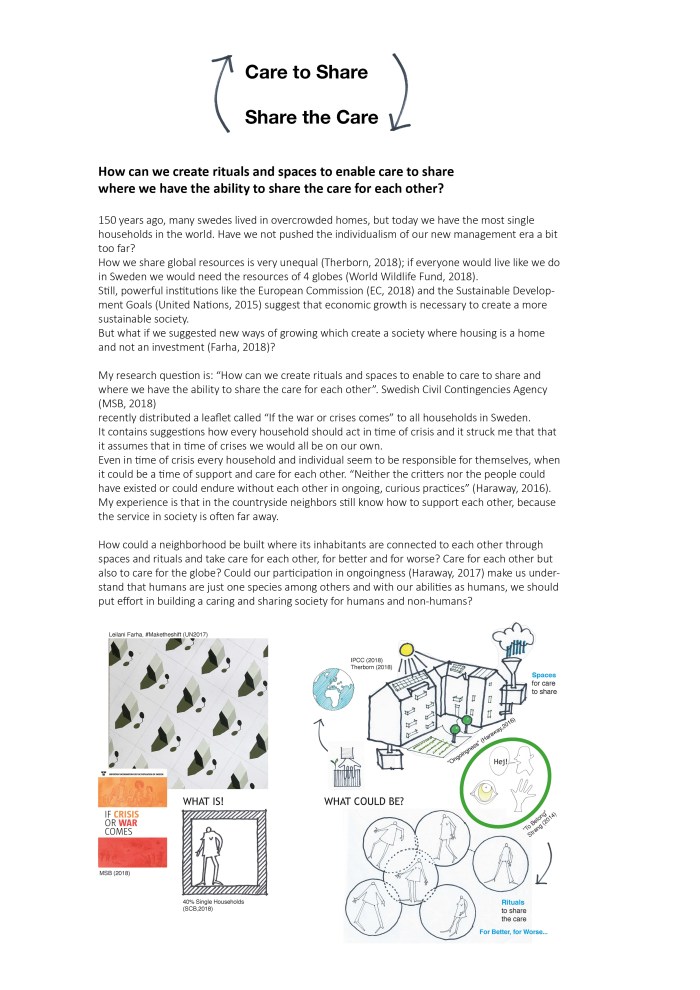
Care to Share, Care the Share

Please find presentation slides from Module 1 bellow. Please note that the files are meant for personal use only, NOT for publication or public disclosure.
1811_roemer van toorn_staging the message_module1
1811_els kuijpers_staging the message_modue1
Historical transformations of the 20th-century European housing exhibition, from a platform of experimentation to the promotion commodities.
By Marcelo Sagot Better, Bauhaus Universiteit Weimar
The thesis reflects on modernity and the processes of massification, led by capitalism upon the growth of technology, that generated a greater shift towards the industrialization of housing units and estates, and the adoption of means of mass communication to legitimize and spread the conceptualization of these developments.
An outcome of this massification that has been often overlooked is the promotion of housing as a spectacle, specifically the permanent housing exhibition as an event that originates at the beginning of the 20th century when artists, urban planners and architects confronted the possibility of their disciplines embracing and re-imagining the modern condition.
These exhibitions were focused on the critique of previous forms of living in urban settlements and the introduction of new approaches to housing together with elaborated schemes for dissemination and communication of the new concepts and designs. Nevertheless, these changes also represent a drastic shift towards the alienation and the transformation of the living unit as a commodity and consequently, its fetishism. The experience of dwell that once was directly lived became mere representation.
As architecture became modern by the process of massification of its content and its form, it is essential to evaluate the spectacle of housing and its broader relation to capitalism, as the aforementioned phenomenon follows the objectives of an economy of power that profits not from the content per se but from an idée fixe with the means of communication and desire for commodities. This condition has been widely analysed as the historical moment at which consumerism thrived and the relation between commodities became more important than any other form of cultural relation, what Guy Debord labels as the complete colonization of social life.
Therefore, the objective of the proposed research is to develop a historical examination of the permanent housing exhibitions developed across Europe during the 20th century as legitimizing spectacles in relation to mass production and mass media, in order to analyse its outcomes and long-term consequences in contemporary forms of consumption of architecture and urban planning.
The role of specific architectural expressions to facilitate local implementation of sustainable development goals in urban policy decision making.
By T.Lic. Pehr Mikael Sällström, KTH School of Architecture
The thesis is based on observations of local implementations of the policies on architecture and environment adopted by the Swedish parliament in 1998 and 1999 with 3 planned case studies.
Complex urban development projects that include new information about conditions for sustainability require innovative programming. Management research on alignment of frames of understanding among actors in urban development projects with vague goals indicate that the use of ‘specific expressions’ can be a mean to coordinate action without complete alignment and facilitate innovative approaches (Sahlin-Andersson 1989).
My thesis is that specific vagueness is a characteristic property of the communication genre of planning directives. I propose that the role of directives is to absorb uncertainty about implementation of sustainable development goals and to facilitate alignment of frames of understanding among the actors. I propose that one condition for such an alignment is that the directives are open to re-definition of both ends and means during the programming stage when the spatial and aesthetic potential of the site are disclosed.
The role of the legal planning tools of an Amended comprehensive plan for a particular part of the municipality (FÖP PBL Ch3§23) and a Programme for detailed development planning (Planprogram PBL Ch5§10) and its aligned programs for urban design quality and environment are analysed. Their relation to negotiation of geographically situated tactical and operative project requirements with the general municipal policy and strategy are discussed.
Based on the first case study of Lomma harbour a provisional model of an urban sustainable development management system is introduced as a frame for the discussion of the following cases to be completed.
I conclude that programming of spaces in urban district developments are better made on the intermediary level between land use planning and detailed planning.
Emerging typologies of residential care facilities for older people
We are witnessing a demographic change with an ageing of the population, putting a pressure on the care systems and residential care facilities. More elderly people are in good health and can take care of themselves at home, but there is also an increase in old people experiencing health problems and cognitive impairments such as dementia. This development is changing the care for elderly people and the architecture of the institutions with new typologies of residential care and emerging spaces of memory care for people with dementia.
This project investigates these transformations of spatial measures in architecture for older people, as a consequence of the changing demographics, progress in health care and technology, as well as political and social aspects.
The research is explorational and will be based on both ethnographic studies and architectural analysis of selected cases, as well as expert interviews and literature studies. The context of the research is the Danish Welfare Society, but as the demographic changes are happening worldwide, it is relevant to link this to developments happening in other countries and cultures. Through this research, the project asks the question of how the architecture is facilitating specific care strategies and supporting the feeling of homeliness in institutional spaces for older people.

 Staging the Message